
Fern Magic
Taking a moment for our plant ancestors.

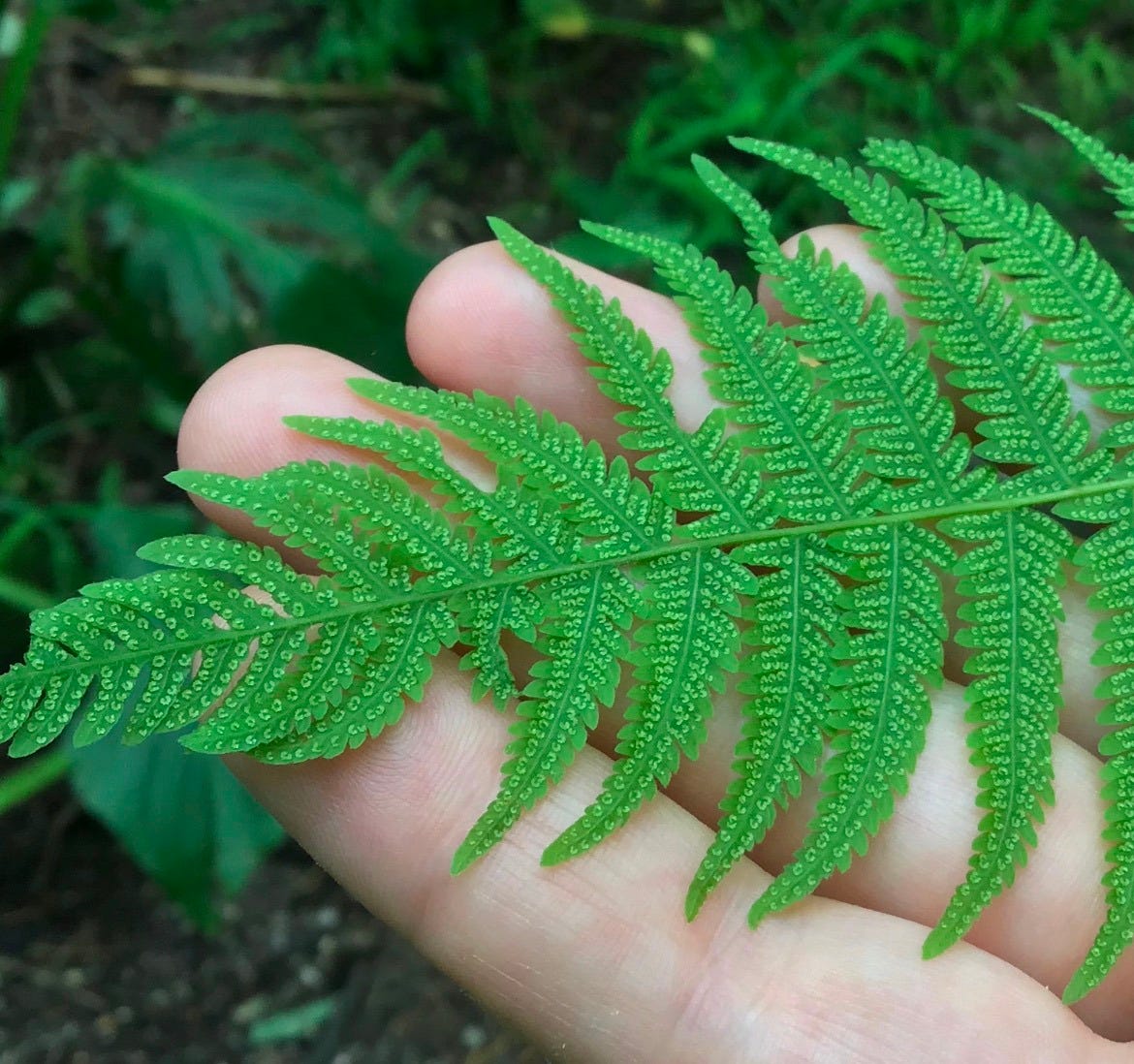
I want to tell you about ferns. Living in the wet Pacific Northwest, I see ferns regularly in my walks around my neighborhood, in my local parks, on virtually every hike. It is no secret: I love this. I delight in flipping over the fronds to see if they have visible sori — the little fuzzy dots where their spores are stored. I take great joy in noticing the ferns growing out of the moss on the sides of old trees. I relish examining their seemingly-similar-but-actually-quite-distinct foliage to learn their ID.
Let’s start at the beginning. Plants have always needed water. Some 500 million years ago, the early land plants (think: algae, moss, liverworts, and their allies) developed a cuticle, a little casing, to keep the water in their cells so they could live on land. They stayed low to the ground, and in moist environments.
Then, the first vascular plants emerged: ferns and their allies. They developed a way to bring the water up and around the plant, rather than just keeping it within a small body. Then, plants were able to grow upward. Ferns once populated the whole of the earth: Tree ferns living amongst the dinosaurs, forests of ferns, fields of ferns. They were the dominant plant.
After ferns, come the gymnosperms, which are largely understood to be our conifers (with some broadleaf trees in the mix). Gymnosperm refers to the “naked seed” of the pine cones and similar plants. Gymnosperms were able to get tall, produce bark, and had the first proper seeds in the history of plants. They are wind-pollinated, largely, so they do their own thing to reproduce.
Then, angiosperms burst into the scene. These are our flowering plants: Our apple trees, our dogwoods, our grasses, our vegetables, our herbs, our cut flowers. As soon as these plants evolved, they were suddenly virtually everywhere on the planet. “Angiosperm” refers to the seeds being stored inside a fruit. Here is where we need pollinators and other critters to distribute the seeds. This cooperation is a huge part of why these plants quickly proliferated. They are, largely, what most people think of when they think of a plant. But they are relatively new to Earth, only developing ~130 million years ago.
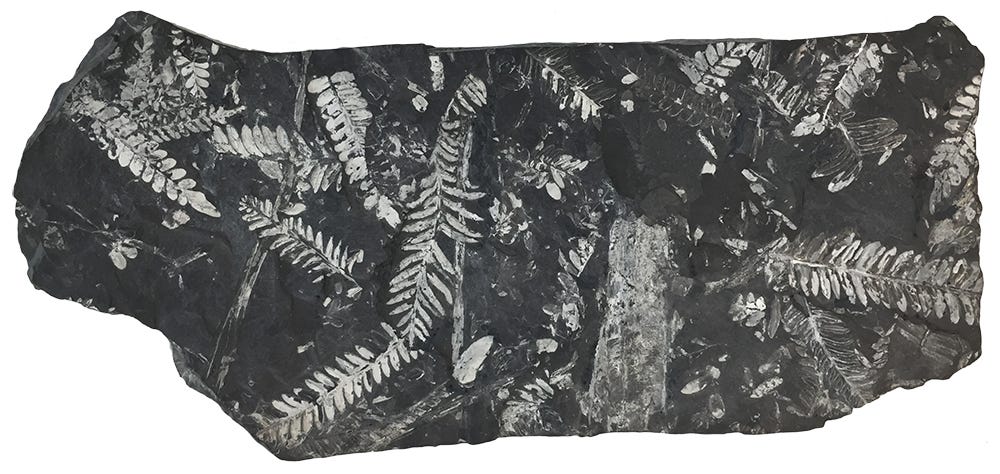
But in this burst of new plants coming onto the scene, the ferns linger in moist, often forested spaces, but they can be found along roadsides with the right conditions. They predate dinosaurs, they predate humans. I read something about how often, as humans age, we become less adaptable and more rigid in how we see and move through the world. Ferns have adapted and persisted for way longer than humans were even beginning to evolve in the world. And they might not be quite as showy as a flower or offer us a tasty fruit, but when you pay attention to them, all of their complexities begin to be apparent. That’s the magic. I see ferns as an ancestor of sorts—an elder that reminds me to be adaptable, and that there is beauty in those changes, if we know where (and how) to look. Through all of the tumult that our planet has experienced, ferns are survivors. And who doesn’t love an underdog to root for?
I hope you take good care this holiday season.
I love ferns too. I had no idea they were so ancient. How interesting!